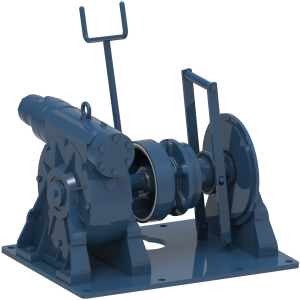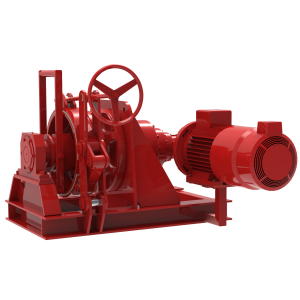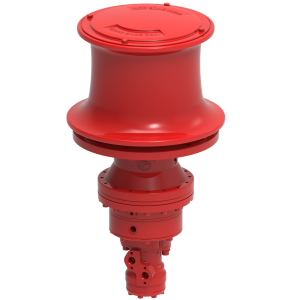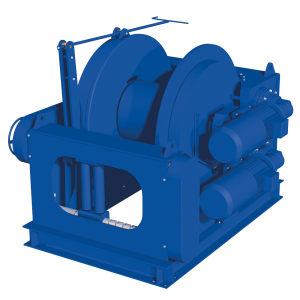
Anchor handling and towing winches for offshore work
In short
- Anchor handling and towing winches do the heaviest, most dynamic deck work there is, deploying anchors and towing vessels against the full force of the sea.
- They combine very high pull with render and controlled recovery, a strong fail safe brake and often an emergency release, because the loads are large and the conditions never sit still.
- Built and classed to offshore standards, with hydraulic drives for force and shock tolerance, they are specialised equipment, not a general winch scaled up.
On the back deck of an anchor handling or towing vessel, the winch is not a convenience, it is the whole point of the ship. It pulls against anchors buried in the seabed and against vessels that weigh thousands of tonnes, in a seaway that is always moving, and it does so with people working close by. Few pieces of deck equipment carry such loads or such consequences, which is why anchor handling and towing winches are a category of their own, engineered and certified to a standard a general winch never has to meet.
The heaviest, most dynamic deck work
What sets these winches apart is the scale and the dynamics of the load together. An anchor handling winch deploys and recovers the anchors and chains that hold rigs and floating structures in place, loads measured in tens or hundreds of tonnes, often with the seabed and the swell both fighting back. A towing winch holds the tow line to another vessel or a barge, a line that surges and snatches as two hulls move independently in the waves. In both cases the winch is not lifting a dead weight in still air, it is managing a living, changing load, and that is a far harder thing to do safely.
Render, recovery and the working brake
Because the load moves, the winch has to move with it. Like a mooring winch, an anchor handling or towing winch can render, paying out line when the tension spikes toward a set limit so the line is not overloaded, and recover, hauling back in when the load eases, keeping the operation under control. Underneath sits a powerful holding brake, fail safe and sized for the full load, because a tow or an anchor line that lets go is among the most dangerous events at sea. The brake, the render setting and the controls work together so the winch holds when it must and gives line when holding would break something, the same principle we describe for mooring and constant tension, scaled up to the heaviest duty.
| Deck winch type | Main job | Key features |
| Anchor handling | Deploy and recover anchors | Very high pull, render, strong brake |
| Towing | Tow a vessel or barge | Render, recovery, emergency release |
| Mooring / capstan | Hold and warp lines | Constant tension, smooth control |
| General deck | Pulling and positioning | Robust, marine protected |
Emergency release and safety
A defining feature of a towing winch is the ability to let go in a hurry. If a tow goes wrong, if the towed vessel sheers or the towing vessel is in danger of being pulled over, the crew must be able to release the line quickly and safely, and a proper towing winch has an emergency release designed for exactly that. Anchor handling brings its own hazards, from the sudden release of a snagged chain to the enormous stored energy in a loaded line, so guarding, controlled stations and clear procedures are built around the winch. None of this is incidental. The whole machine is designed on the assumption that the load is large, the sea is moving and something will eventually go wrong, and that the equipment must keep the crew safe when it does.
Why hydraulic, and why classed
These winches are almost always hydraulic, and for the same reasons hydraulics rule the deck generally: the highest force for the size, smooth metering of line in and out, and the toughness to take shock, salt water and continuous duty without complaint, points we set out in our guide to hydraulic winches for offshore deck work. They are also built and certified to offshore standards and frequently classed by a society such as DNV, ABS, BV or Lloyd's, with the documentation and traceability that serious marine operations require. A winch handling anchors or tows without that pedigree is not a saving, it is a liability waiting for a bad day.
Bollard pull, line pull and sizing
Sizing one of these winches is a conversation about forces, not just weights. For towing, the winch and line have to match the vessel's bollard pull, the steady pull the ship can exert, with margin for the dynamic snatch loads the sea adds on top. For anchor handling, the winch is sized to the anchors, chains and wires it will deploy and to the tension needed to set and break them out of the seabed, again with allowance for the dynamics. Drum capacity has to suit the length of wire or chain carried, and the brake and render settings are matched to the line's breaking load so the winch always protects the rope. This is detailed, safety critical sizing, exactly the kind of work that belongs with an engineer rather than a price list.
Where these winches work
The setting is the offshore and marine heavy end. Anchor handling and towing supply vessels serve rigs, platforms and floating production units, moving their anchors and towing structures into position. Salvage and emergency response vessels tow stricken ships. Construction and installation vessels deploy and recover heavy ground tackle. Harbour and coastal tugs tow barges and assist large vessels. In all of them the winch is the tool that turns the vessel's power into useful, controlled force on a line, and the difference between a winch built for this and one that is not is measured in safety, capability and the confidence to work when the weather is against you.
Keeping a deck winch safe in service
A winch this important is only as safe as its upkeep. The wire and chain it handles are inspected and retired against recognised criteria, the brake is tested to a defined load to prove it holds, and the render and release functions are checked so they work the day they are needed rather than the day they are not. Salt water never stops attacking the machine, so the corrosion protection, the seals and the lubrication are watched as closely as the mechanism itself, the same discipline we set out for marine winches and corrosion. On a classed vessel this maintenance is documented and surveyed, which is part of why a recognised pedigree matters.
The crew side matters just as much. These are powerful machines working with enormous stored energy close to people, so trained operators, clear stations, guarding and firm procedures are part of the system, not an afterthought. The winch is engineered to fail safe and to release in an emergency, but it is the combination of good equipment and good practice that keeps the back deck safe. When we supply or specify a deck winch we provide the documentation and the maintenance guidance with it, so the machine that does the hardest work on the ship stays fit to do it.
Heavy hydraulic deck winches
For heavy warping, mooring and deck work our hydraulic capstans run up to the powerful C 305 H and C 306 H, and dedicated anchor handling and towing packages are engineered to the vessel and its duty. The wider marine programme is in our winch catalogue, and the related case for mooring and constant tension is set out in our mooring winch guide. Tell us the vessel, the bollard pull and the line, and we engineer the deck winch around the real forces.
Frequently asked questions
What is an anchor handling winch?
A heavy deck winch that deploys and recovers the anchors, chains and wires holding rigs and floating structures in place. It combines very high pull with render, a strong fail safe brake and offshore certification, because the loads and the dynamics are extreme.
What does a towing winch do?
It holds and manages the tow line to another vessel or barge, rendering when the tension surges and recovering when it eases, with a fail safe brake and an emergency release so the line can be let go quickly and safely if the tow goes wrong.
Why are these winches hydraulic?
Because hydraulic drives give the highest force for their size, meter line smoothly, and tolerate shock loads, salt water and continuous duty, all of which anchor handling and towing demand. They also share the vessel's hydraulic power.
Do anchor handling and towing winches need classification?
Yes. They are built and certified to offshore standards and frequently classed by a society such as DNV, ABS or BV, with full documentation. The loads and the consequences make a recognised pedigree essential, not optional.