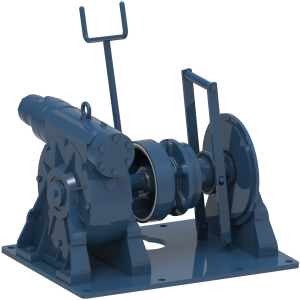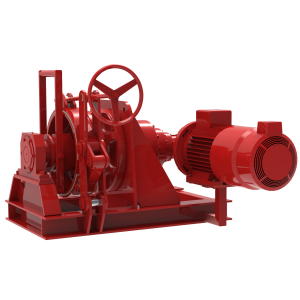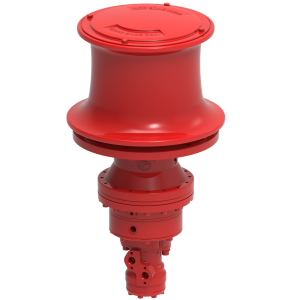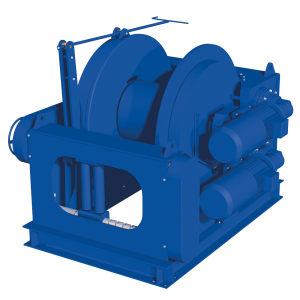
Free-fall winches for piling and drilling
In short
- A free-fall winch can release the drum so the load drops under its own weight, then re-engage to brake and hoist it, which a standard winch cannot do.
- Free fall is used where a tool must descend fast, such as driving a pile, sinking a grab or advancing a drill, and the speed of the drop does real work.
- Because the load is briefly under gravity rather than the motor, the clutch and brake, and a trained operator, are everything; control is what makes free fall safe.
Most winches only ever drive the load: the motor raises it and the brake lowers it under control, and the drum is never free to spin on its own. A free-fall winch adds something different. It can disconnect the drum from the drive so the rope pays out freely and the load drops under its own weight, then re-engage to catch and hoist it again. That ability sounds alarming out of context, but it is exactly what certain heavy jobs need, and done with the right clutch, brake and operator it is a controlled, productive tool rather than a loss of control.
What free fall actually means
In normal use a free-fall winch behaves like any other: the motor hoists, the brake lowers, the load is always held. The difference is a clutch that can disconnect the drum from the gearing. When the operator releases it, the drum is free to spin, the rope runs out, and whatever is on the end falls under gravity, fast. When the operator wants to stop the drop, the brake takes the load and the clutch can re-engage the drive to hoist again. So free fall is not a winch that has lost its grip; it is a winch that can choose, on command, to let the load run and then retake it.
Why a job would want the load to drop
The reason is that for some tools the speed and energy of the drop do the work. Driving a pile or a casing, the falling hammer or the weight of the tool itself delivers the blow. Sinking a grab or a bucket into ground or water, letting it free fall makes it bite. Advancing some drilling and foundation tools, a controlled drop is faster and more effective than winching down under power. In these jobs a winch that could only lower slowly under the motor would be slow and would not deliver the impact, so the ability to free fall is not a gimmick but the point of the machine.
| Mode | How it works | Used for |
| Powered hoist | Motor raises and lowers | Controlled lifting |
| Controlled lower | Brake feeds rope out | Gentle landing |
| Free fall | Clutch released, load drops | Fast tool descent |
| Re-engage | Clutch and brake retake load | Stop and lift again |
The clutch and brake are everything
Because the load spends moments under gravity rather than under the motor, the parts that control the drop carry the whole responsibility for safety. The clutch must release and re-engage cleanly and predictably, and the brake must be able to arrest a falling load smoothly and hold it, repeatedly, without fade. These are not ordinary components asked to do ordinary work; they are asked to manage real energy on demand, and they are sized, specified and maintained accordingly. A free-fall winch lives or dies on its brake and clutch, which is why these machines are built around them rather than treating them as accessories.
Control is what makes it safe
A free-fall winch is safe not because the load never moves freely but because the operator commands exactly when it does and stops it precisely. That demands a machine whose controls are clear and responsive, and an operator trained in the work, because a free-falling load is unforgiving of hesitation or error. The drop is started deliberately, watched, and arrested under control, never allowed to run on blind. Good free-fall winches make this easy with positive, well placed controls, but the principle is constant: the safety comes from control, and the machine and the operator together provide it.
Where free-fall winches are used
These winches are the heavy specialists of the winching world. In piling and foundation work they drive piles and casings and advance tools. On drilling rigs they handle tools that benefit from a controlled drop. In dredging and grab work they sink the grab fast to make it dig. In some salvage and civil engineering tasks the controlled drop places or sets a load that powered lowering could not. In all of these the work is heavy, the duty demanding, and the free-fall capability central, which is why these are robust, purpose built machines rather than general winches with an extra mode.
Free fall and the rest of the winch
The free-fall capability sits on top of everything a good winch needs anyway. The drum must hold the rope and the pull as on any winch, the subject of our note on drum and rope capacity, and the rope itself must be sound and inspected, since free fall and the shock of arresting a drop are hard on it. Many free-fall winches are hydraulic, because hydraulics suit the heavy, mobile, harsh duty these jobs involve and tolerate the stalling and impact, as our piece on hydraulic winches describes. The free-fall function is the headline, but it only works on top of a sound, well specified winch underneath.
Maintenance and inspection
A free-fall winch works its safety critical parts harder than an ordinary winch, so it asks for more attentive maintenance, not less. The brake takes the energy of arresting falling loads again and again, so its condition, the lining, the springs or hydraulics that apply it, and its holding ability, is checked regularly and never allowed to drift toward fade. The clutch must keep releasing and re-engaging cleanly, because a clutch that grabs or slips at the wrong moment is dangerous, so its wear and adjustment are watched. The rope sees shock loads when a drop is caught, which accelerates fatigue, so it is inspected more often and to the same discard criteria as any rope, with particular attention to the terminations. The controls that command the drop must stay positive and predictable, since hesitation in the linkage becomes hesitation in a falling load. None of this is exotic, but it is more demanding than the upkeep of a winch that only ever lowers under power, and it is part of owning a free-fall machine. A free-fall winch maintained by people who understand what its brake and clutch are doing stays safe and productive; one maintained as if it were an ordinary winch can hide a developing fault in exactly the parts that must never fail.
Specifying a free-fall winch with us
Free-fall winches are specialist machines, and we specify them around the tool, the energy of the drop and the duty, not from a shelf. See the wider range in our winch catalogue, read our overview of hydraulic winches and how the brake holds the load, which matters doubly here. Tell us the tool, the weight, how fast it must drop and how often, and we will specify a free-fall winch whose clutch and brake are built for the real work rather than borrowed from a lighter machine.
Frequently asked questions
What is a free-fall winch?
A free-fall winch can disconnect the drum from the drive so the load drops under its own weight, then re-engage to brake and hoist it. In normal use it works like any winch; the difference is a clutch that lets the operator release the drum on command and a brake that retakes the load.
Why would you want the load to free fall?
Because for some tools the speed and energy of the drop do the work. Driving a pile, sinking a grab or advancing a drilling tool, a controlled drop delivers impact and bites faster than winching down under power. In those jobs free fall is the point of the machine, not a gimmick.
Is a free-fall winch safe?
Yes, when the clutch, brake and operator are right. The load only moves freely when the operator commands it and is arrested under control by the brake. These winches are built around a reliable clutch and a fade free brake, and they demand a trained operator, because a falling load is unforgiving of error.
Are free-fall winches hydraulic or electric?
Many are hydraulic, because hydraulics suit the heavy, mobile, harsh duty of piling, drilling and dredging and tolerate the stalling and impact involved. The free-fall function can be built on either, but the demanding work it is used for often points to hydraulic drive.